Inspect before washing
Empty pockets and look for visible damage. A tear or detached seam tape may need assessment before washing could enlarge it. Remove loose belongings and handle detachable components as instructed. A visible connection does not automatically mean a hood or lining is intended for removal.
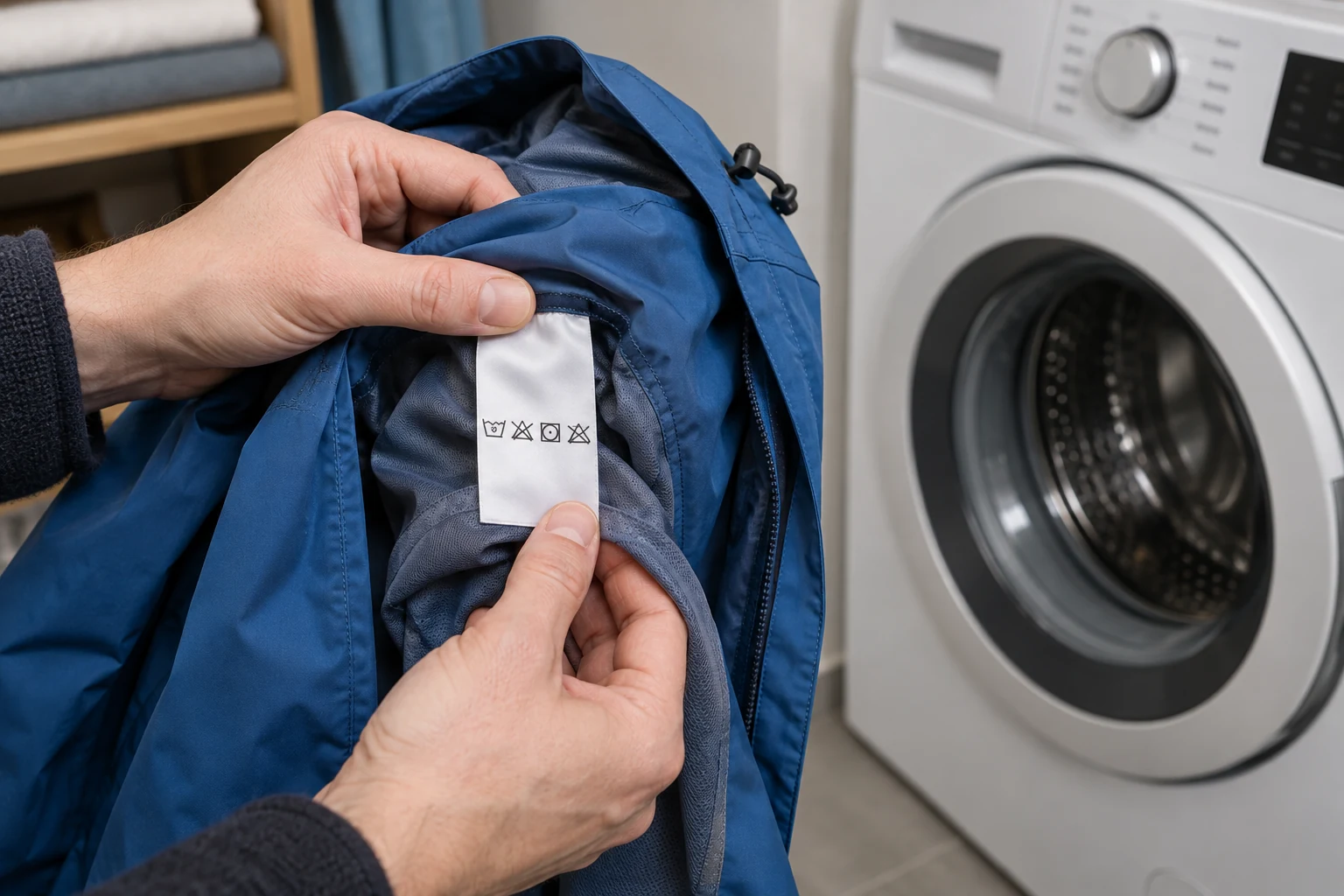
Read the sewn care label and model guidance. GORE-TEX explicitly asks users to follow the garment maker's instructions as well as its general advice. Different constructions can permit different temperatures and drying. A familiar membrane name does not replace your jacket's label.
Look for special constructions. An exposed-membrane garment can need different treatment from a conventional face fabric. GORE-TEX describes separate restrictions for such cases. Do not select the easiest individual rule from general guidance when the model specifies an exception.
Prepare the closures
Close zips and secure flaps as directed. First remove grit and trapped fabric. Washing does not repair an already damaged slider; assess that separately before preparing the garment.
Examine cuffs, collar, and hem for residues less visible on broad panels. Perform approved pretreatment gently. Do not experiment with strong stain remover around bonded or coated areas.
Use suitable cleaner and equipment
For conventional outerwear, GORE-TEX describes a small quantity of liquid detergent and restrictions on softener and other additives. Check your garment's requirements. More detergent does not automatically clean better and leaves more residue to remove.
Inspect the detergent drawer for previous additives. Follow the machine's cleaning or rinsing guidance where relevant. Avoid combining the shell with heavily soiled coarse items and unknown treatments. The complete load should suit the permitted programme.
Choose temperature, spin, and rinsing by the label. GORE-TEX recommends thorough rinsing and reduced mechanical stress for relevant products, but this is not one universal setting for every waterproof jacket. Record the successful permitted programme if choosing it would otherwise become uncertain again.
Rinse away residue
Remove cleaner as instructed; foam is not a protective layer. An additional rinse may belong to the approved procedure. Avoid forceful wringing and examine closed pockets after removal.
Distinguish remaining dirt from material changes. A dark area does not automatically justify a stronger second treatment. For uncertain coating or sticky seam tape, ask for guidance. Washing and assessing material ageing are different tasks.
Use only permitted heat
Some shells allow gentle tumble drying and a defined heat stage to reactivate exterior repellency. Others prohibit dryers or ironing. Do not transfer one duration or temperature to all garments. Permission for the actual jacket governs.
Where ironing is allowed as an alternative, use the specified settings and protective layer. A hot iron directly on an unidentified surface is not a shortcut. Check folds and pockets for complete drying rather than only touching the front panel.
Assess after washing
Water repellency concerns droplets on the exterior. Internal dryness also depends on construction, condition, and use. Reduced beading alone does not prove membrane damage, while new reproofing cannot repair a torn barrier.
Store the clean dry shell without severe prolonged compression and retain the care details. If repellency does not return after permitted washing and reactivation, investigate compatible retreatment. That is a separate step, not a reason to add more detergent next time.