Not every object needs another bag
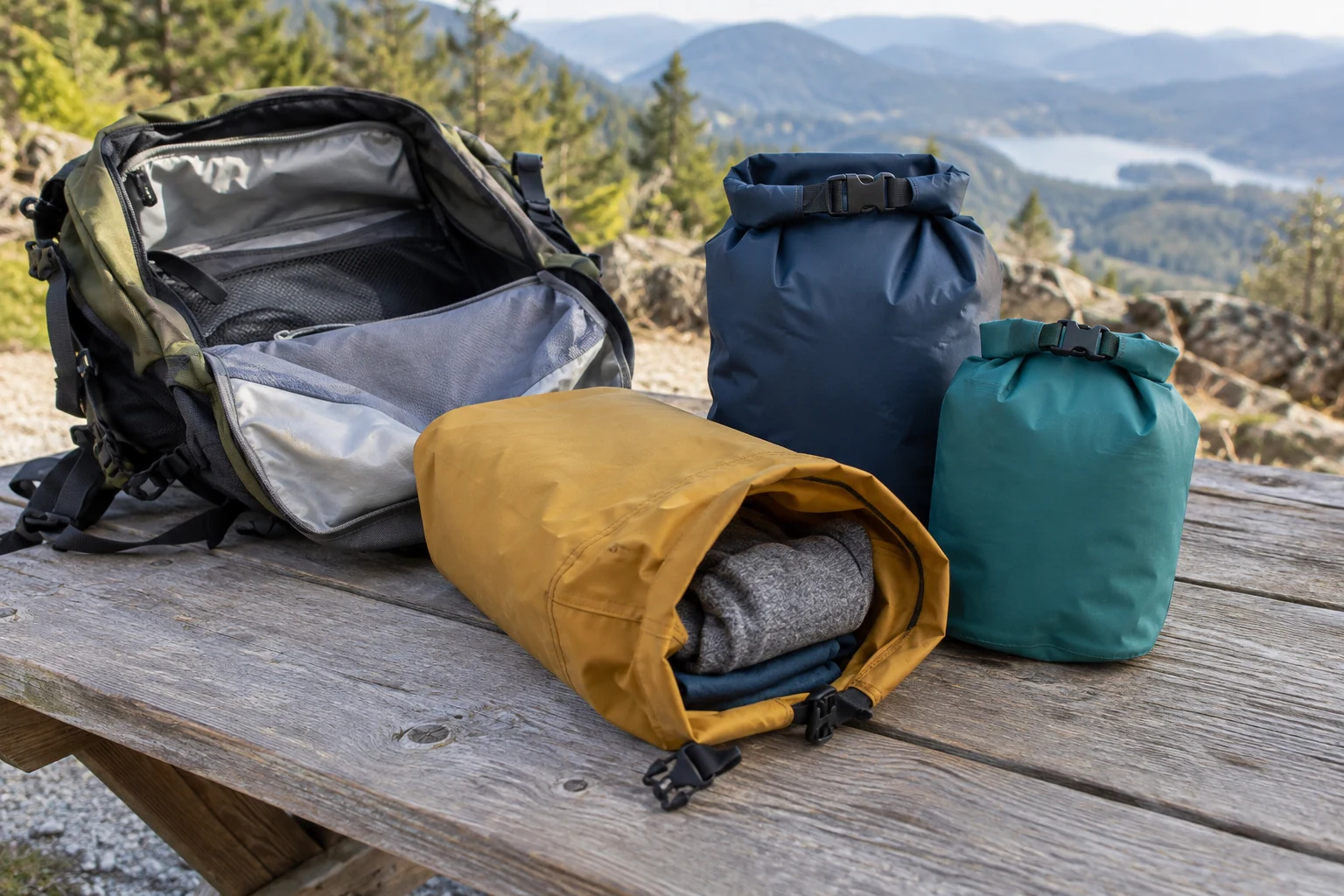
Dry bags help when they have a defined purpose. One may keep spare clothing together, while another contains sensitive small belongings. Five similar bags without clear assignments do not necessarily make a small pack easier to understand. Begin with the items that genuinely need separation or protection.
Distinguish a simple fabric stuff sack from a bag explicitly designed for water protection. Both organize contents, but they do not offer equivalent resistance. Check the material, seams, and closure description. Even when a fabric is waterproof, the complete construction determines the conditions for which the product is intended.
Group items by retrieval
Put together things you use at the same time. Spare clothing can remain grouped, while a map and frequently used accessories may need a different location. Colour coding helps when used consistently. A light interior can make small items easier to see, but a transparent window does not replace an appropriate size.
Do not place a rarely used clothing bag over your rain layer if that requires emptying the compartment at every shower. Placement within the pack still matters. A closed bag protects its own contents, but cannot prevent you opening it in rain or putting it on wet ground. Choose the unpacking location deliberately.
Leave room for the roll closure
Keep enough material free at the top. Follow the instructions for the number and direction of turns; folding the edge once does not automatically create a proper seal. Expel surplus air where the design permits before securing the closure. Bags should occupy the space usefully rather than become inflated balls competing for room.
Lightweight internal sacks are not necessarily suitable for external carrying. Abrasion resistance, attachment points, and intended use differ. Do not suspend a thin bag outside by its buckle alone unless the maker allows it. Sensitive electronics also require attention to the manufacturer's explicit protection limits.
Separate damp belongings on the return
An extra empty bag may contain a damp layer temporarily, provided you unpack it at home. Keeping wet belongings sealed indefinitely is not care. Clean dirty bags as directed, rinse away residue, and dry them open. Examine the rolling edge and inner barrier while doing so. Organization works best when you know the condition of the bags as well as their contents.