Try a real set of contents
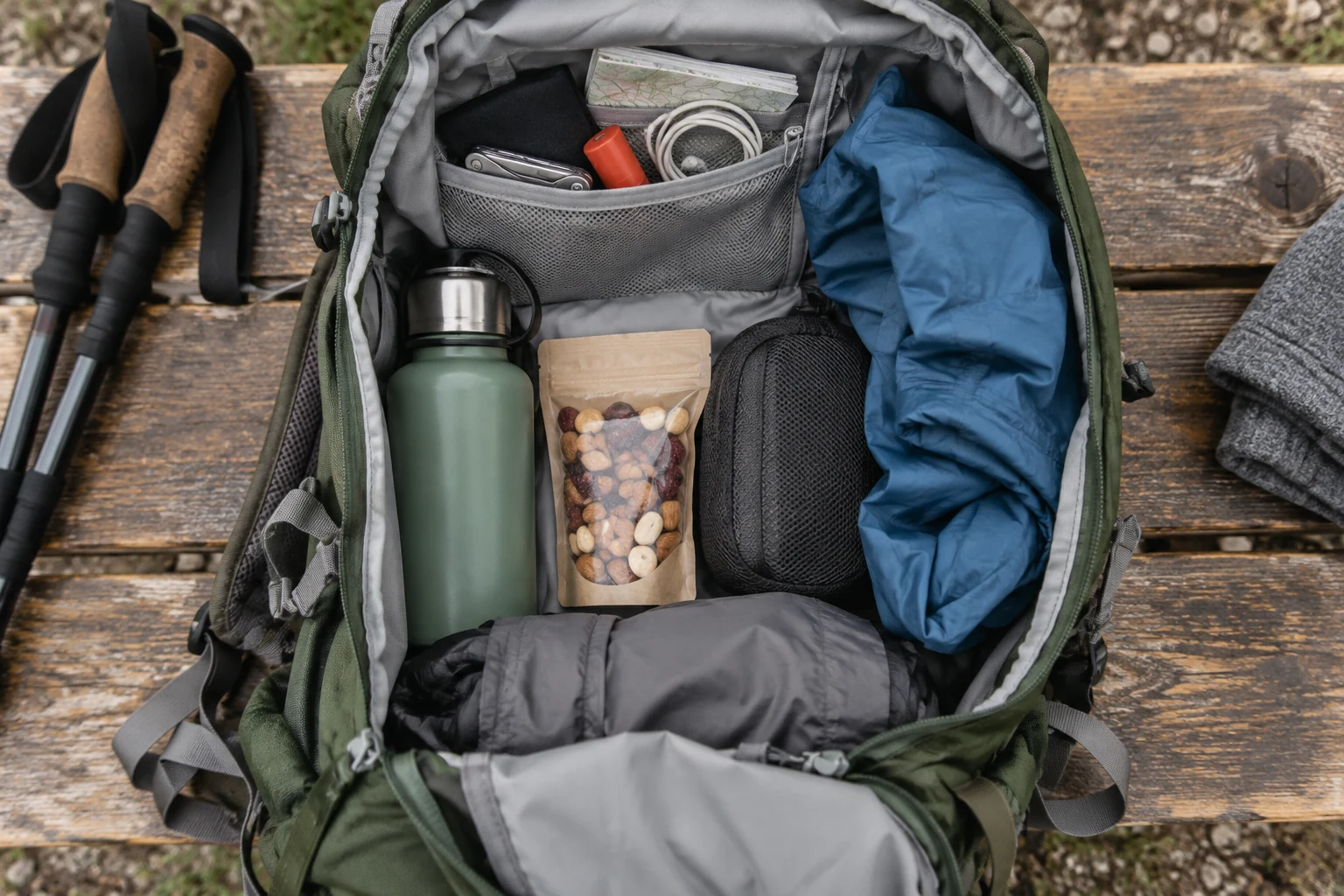
Place water, a lunch box, spare clothing, a rain layer, and small essentials beside the empty pack. Separate dense objects from bulky soft items. A full bottle takes relatively little space for its weight; a fleece may occupy considerable volume while remaining light. That distinction is more useful for placement than the order in which you happen to pick things up.
The German Alpine Club recommends keeping dense equipment close to the back and balancing the load from side to side. For a daypack, that can mean avoiding a full bottle at the very outside behind thick clothing. Its precise height depends on the pack's shape and other contents. A small compartment offers different options from a large trekking bag.
Stabilize dense items
Position a bottle so that it cannot change place with every step. A suitable sleeve or closely packed area can help. Arrange light clothing around rigid objects without forcing it into every gap. Check that hard edges are not pressing directly against the backpanel.
If you carry bottles on both sides, consider the balance after using some water too. Exact gram matching is unnecessary, but a pronounced difference is worth noticing. Compression straps may bring the contents together. Tighten them after packing, then check whether they have blocked a pocket you need.
Arrange access around the actual walk
Put the rain layer somewhere reachable without prolonged unpacking when a shower begins. Equipment intended for an urgent need should likewise not disappear beneath everything else. Packing lists differ in detail; do not copy a sequence that prevents useful access in your particular model.
Group small items by purpose. Keys belong in a closed pocket or on a designated clip, while snacks need an accessible location. Ideally, a wet jacket has a separate place rather than wrapping around a dry spare layer. Allow for that space before departure rather than inventing it after the first shower.
Check after a few minutes
Walk with the loaded pack and then stop briefly. Has the lunch box turned? Is a strap end hanging loose? Does consulting the map require opening the whole bag? These observations identify worthwhile changes. Keep an arrangement that works and adjust individual areas deliberately. A repeatable routine reduces searching without requiring a separate pouch for every object you carry.